Living in Milpitas: A Neighborhood Guide for Home Buyers
Home Buying
Home Buying
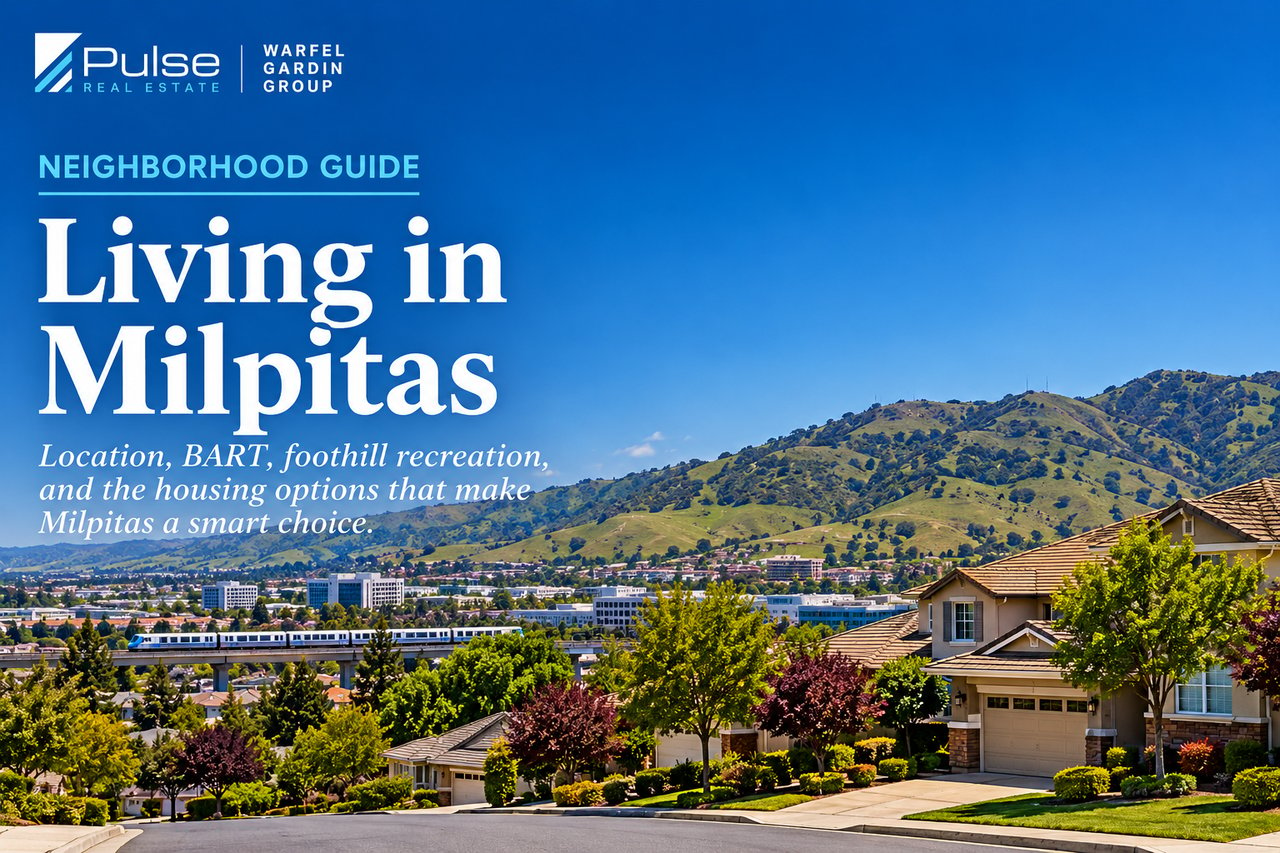
Homes, neighborhoods, BART, Silicon Valley access, foothill recreation, and what buyers should know before choosing Milpitas
Milpitas occupies a strategic position at the crossroads of Silicon Valley.
Located between San Jose, Fremont and the East Bay, the city offers direct access to I-880, I-680 and Highway 237, along with BART and VTA light rail. For buyers whose work or daily life takes them to different parts of Silicon Valley or the East Bay, that connectivity can be one of Milpitas's biggest advantages. The city itself calls Milpitas the “Crossroads of Silicon Valley.” Milpitas
But convenience isn't the whole story.
Milpitas includes established single-family neighborhoods, newer townhomes and condominiums, transit-oriented development near BART, and residential areas that extend toward the foothills.
That means the better question isn't simply:
“Should I buy in Milpitas?”
It's:
“Which part of Milpitas best fits the way I want to live?”
Milpitas is a relatively compact city with a surprisingly varied residential environment.
The western side is closely connected to major employment areas, freeways, transit and the Great Mall. Move east and the setting becomes increasingly residential, eventually reaching the foothills and open space along the city's eastern edge.
That geography creates options.
Some buyers prioritize a shorter commute and access to BART. Others want an established single-family neighborhood with a yard. Still others prefer newer construction with less immediate maintenance.
Milpitas can accommodate all three better than many buyers initially expect.
Rather than thinking of Milpitas as one housing market, it helps to consider several different residential settings.
Much of Milpitas consists of established single-family neighborhoods developed during the second half of the 20th century.
Buyers will find ranch-style homes, two-story houses, cul-de-sacs and properties that range from largely original to extensively remodeled.
These neighborhoods can appeal to buyers who want a conventional single-family home and yard while remaining close to major Silicon Valley employment centers.
As with any established neighborhood, condition matters. Two similar-looking homes can have very different histories when it comes to roofing, plumbing, electrical systems, HVAC, additions and remodeling.
Milpitas changes as you move toward the eastern foothills.
Residential areas closer to the hills can provide a quieter setting and convenient access to outdoor recreation while still remaining surprisingly close to the city's commercial areas and transportation corridors.
Properties near the foothills can also raise different questions from homes farther west. Depending on the location, buyers may want to investigate drainage, slope, vegetation, insurance and other property-specific considerations.
The area around the Milpitas Transit Center represents a very different side of the city.
Milpitas has been transforming what was once primarily an industrial and auto-oriented area around the station into a higher-density, transit-oriented neighborhood with housing, parks, shops and improved pedestrian connections. The city's current Metro Specific Plan covers approximately 510 acres around this area. Milpitas
Here, buyers are more likely to find condominiums, townhomes and newer higher-density housing than in Milpitas's established single-family neighborhoods.
For buyers who value transit and lower-maintenance housing, this part of Milpitas deserves particular attention.
Milpitas offers a broader housing mix than many buyers realize.
You'll find established single-family homes, remodeled properties, larger homes built during later periods of development, townhomes, condominiums and newer transit-oriented housing.
That variety can make Milpitas useful for buyers at different stages of homeownership.
A first-time buyer considering a condominium near transit has a very different set of priorities from a move-up buyer looking for a larger single-family home near the foothills.
For older homes, we pay particular attention to major systems, previous improvements and permit history.
For condominiums and townhomes, the investigation changes. HOA finances, reserves, insurance, assessments, rules and responsibility for building components can be just as important as the condition of the unit itself.
The diligence should match the property.
Location may be Milpitas's strongest competitive advantage.
I-880 connects toward San Jose, Santa Clara and the East Bay. I-680 provides another north-south route, while Highway 237 connects Milpitas with North San Jose, Sunnyvale and Mountain View.
That can be particularly valuable in a household where two people commute in different directions.
Milpitas is also surrounded by major technology and employment centers rather than being dependent on a single employment corridor.
But freeway access doesn't automatically mean a short commute. Traffic patterns vary significantly by route and time of day.
As with any Silicon Valley home purchase, we recommend testing the actual commute from the property at approximately the time you'll normally travel.
Transit is one of the features that now distinguishes Milpitas from many South Bay communities.
The Milpitas Transit Center combines BART with VTA light rail and bus service near the Great Mall. VTA describes the station as a regional connection to the technology-heavy employment areas of northwestern Santa Clara County. VTA
VTA's Orange Line also connects Milpitas with destinations including Mountain View, Great America and East San Jose, while additional bus routes connect the station with other parts of Silicon Valley. VTA
For a buyer who expects to use transit regularly, proximity to the station can materially change the value of a particular location.
For someone who will drive almost everywhere, it may matter much less.
That's why we treat transit access as a buyer-specific benefit, not automatically a reason to pay more for a home.
The industrial and technology corridors along Milpitas's western side can obscure a very different landscape on the eastern edge of the city.
Ed R. Levin County Park encompasses approximately 1,558 acres in the foothills and provides hiking, horseback riding, fishing, picnicking and trails leading toward Monument Peak, with expansive views across the Santa Clara Valley and San Francisco Bay. Milpitas
Milpitas also has more than 30 park locations offering a variety of recreational facilities. Milpitas
That creates an interesting contrast.
A resident can be close to BART, major freeways and some of Silicon Valley's largest employment areas while also having substantial foothill open space only a short drive away.
For buyers who don't know Milpitas well, that's often one of the community's more pleasant surprises.
The Great Mall is Milpitas's most prominent retail destination and is closely connected with the BART/transit area.
But everyday shopping isn't concentrated in a single downtown.
Milpitas has commercial centers distributed throughout the city, along with restaurants and services reflecting the diversity of the surrounding community.
That's an important lifestyle distinction.
Milpitas doesn't offer a traditional downtown experience comparable with Los Gatos or Campbell. Its advantage is generally convenience and access rather than a historic town center.
For some buyers, that's a worthwhile trade.
Milpitas Unified School District serves much of the city, but buyers shouldn't choose a home based solely on a school shown in a real estate listing.
If schools are important to your decision, verify the current attendance assignment for the exact property directly with the applicable school district.
We prefer that approach throughout Silicon Valley because school boundaries and enrollment circumstances can change.
Milpitas can be particularly interesting to buyers comparing what the same budget buys in different parts of Silicon Valley.
But citywide averages aren't enough.
A newer townhome near BART, an established single-family home and a foothill-area property provide very different ownership experiences.
Value can be affected by:
Rather than starting with a citywide median, we prefer comparing the particular home with the most relevant recent sales.
The better question is:
What are you trying to get from Milpitas that your budget doesn't provide somewhere else?
For many buyers, the answer is some combination of housing, commute flexibility and location.
Milpitas and North San Jose are natural comparisons for buyers focused on Silicon Valley employment centers, freeway access and newer housing options.
Both can provide convenient access to the technology corridors around North San Jose and Santa Clara, and both offer BART or VTA connections depending on the location.
But there are meaningful differences.
Milpitas is its own city with established residential neighborhoods extending from the transit area to the eastern foothills. Buyers can choose among older single-family neighborhoods, newer developments and transit-oriented housing while remaining within a relatively compact community.
North San Jose contains substantial newer development and is closely integrated with some of Silicon Valley's largest employment areas, but its residential environment can feel more closely intertwined with office, industrial and newer mixed-use development.
For buyers considering both, we'd focus on the individual property, commute, housing type and neighborhood setting rather than assuming one location is automatically better.
Milpitas deserves consideration if you value:
It can be especially useful for households with commutes pulling in different directions.
Milpitas won't be the best fit for every buyer.
If a walkable historic downtown is a major priority, Campbell or Los Gatos may appeal more.
If your daily life is centered much farther up the Peninsula, another location may shorten your commute.
And buyers sensitive to freeway, commercial or industrial surroundings should evaluate the exact location carefully rather than treating all of Milpitas alike.
That's really the theme of buying here:
Location within Milpitas matters.
Yes. The Milpitas Transit Center includes BART and connections with VTA light rail and buses near the Great Mall. BART passenger service at Milpitas began in 2020. VTA
It can be. Milpitas sits near I-880, I-680 and Highway 237 and has BART and VTA connections. The actual advantage depends on where you work and where within Milpitas you live.
No. Established neighborhoods contain many single-family homes, while buyers can also find condominiums, townhomes and newer higher-density housing, particularly around the transit area.
Yes. Ed R. Levin County Park provides approximately 1,558 acres of foothill open space with hiking, horseback riding, fishing and other recreation. Milpitas
Not in the same sense as communities such as Campbell or Los Gatos. Shopping, dining and services are spread among several commercial areas, with the Great Mall and developing Metro area among the city's larger activity centers.
Both offer strong access to Silicon Valley employment centers and transportation. Milpitas provides its own established residential neighborhoods and foothill areas in addition to newer transit-oriented housing, while North San Jose has a greater concentration of newer development integrated with major employment districts.
Milpitas's biggest advantage is connectivity.
Few South Bay communities combine direct access to I-880, I-680 and Highway 237 with BART, VTA light rail, major employment corridors and proximity to the East Bay. Milpitas
But there's more to Milpitas than its location.
Buyers can choose among established single-family neighborhoods, foothill settings, townhomes, condominiums and newer development around the transit area. Ed R. Levin County Park adds a substantial outdoor component that buyers unfamiliar with the city may not expect.
So rather than asking:
“Is Milpitas a good place to buy?”
We'd start with:
“What do you want Milpitas's location to do for you?”
Then we can determine which part of the city — and which individual property — best accomplishes it.
As co-founders of the Warfel Gardin Group at Pulse Real Estate, Dale Warfel and Helen Gardin work directly with clients throughout the buying and selling process.
For buyers, we help compare neighborhoods and housing types, evaluate relevant sales, understand how location affects value, verify school information, review property and permit history, and identify issues that deserve further investigation.
For sellers, we take the same property-specific approach. A single-family home near the foothills should not be positioned exactly like a townhome near BART. We look at the property, its likely buyer and the most relevant competing homes before developing the pricing and marketing strategy.
Considering buying or selling a home in Milpitas? Call or text Dale and Helen at 408-647-7211. We'd be happy to talk through your plans and help you determine the best next step.
Pulse Real Estate (The Warfel Gardin Group) is the Silicon Valley and South Bay residential team where every client works directly with both Dale Warfel (Founder, Realtor®, DRE #01437945) and Helen Gardin (Founder, Realtor®, DRE #01938063), from the first conversation to the day the keys change hands.
Personal attention does not mean limited resources: they coordinate a full bench of trusted specialists including lenders, contractors, inspectors, stagers and escrow.
425+ Homes Sold · 160+ 5-Star Reviews · $365 Million+ Sales Volume.
Both are Certified Probate & Trust Specialists.
Office: 1900 Camden Ave., #101, San Jose, CA 95124.
Call or text 408-647-7211, or visit mypulserealestate.com.
Stay up to date on the latest real estate trends.
Home Buying
Homes, neighborhoods, BART, Silicon Valley access, foothill recreation, and what buyers should know before choosing Milpitas


Home Buying
What Buyers and Sellers Should Know

Home Buying
Neighborhoods, homes, schools, commute considerations, and what buyers should know before choosing Palo Alto
You’ve got questions and we can’t wait to answer them.