Living in Palo Alto: A Neighborhood Guide for Home Buyers
Home Buying
Home Buying
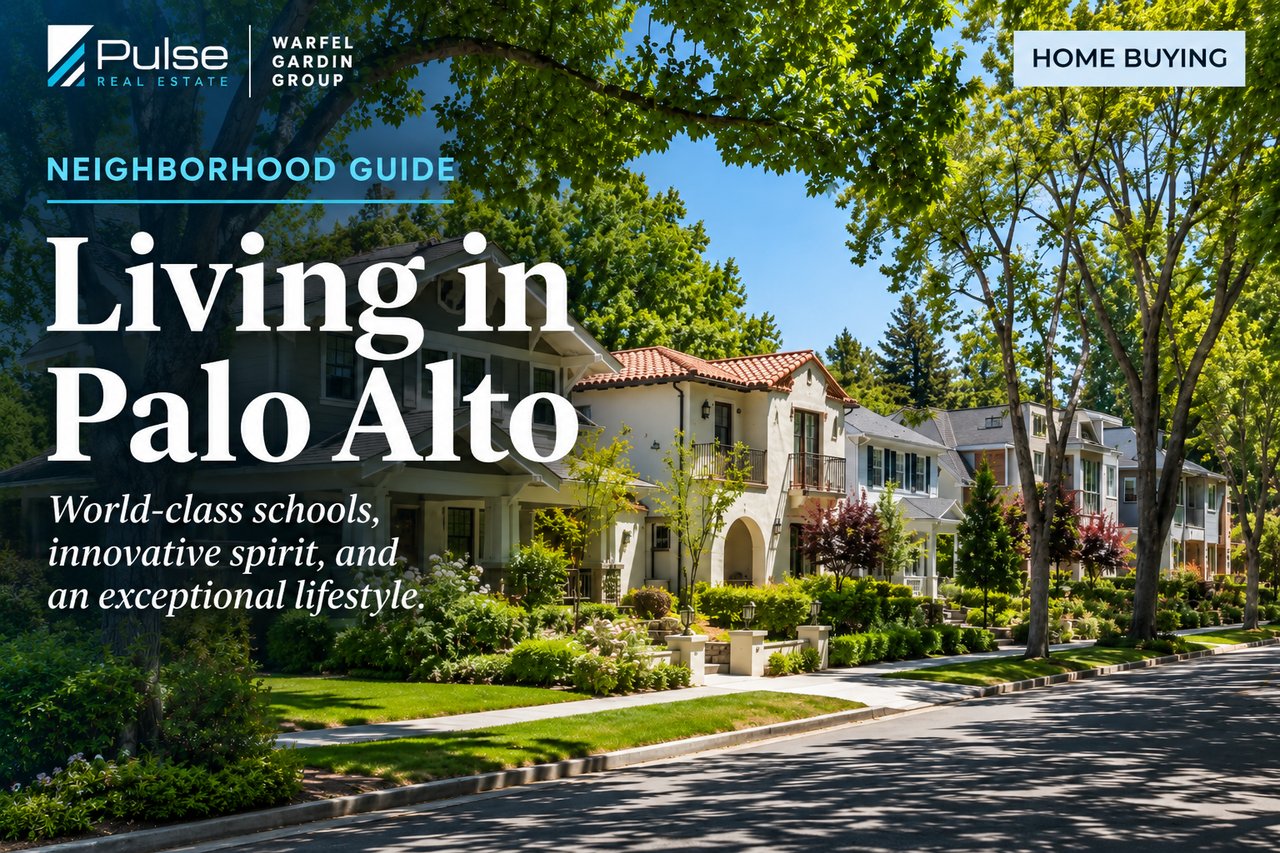
Palo Alto combines established residential neighborhoods with active commercial districts, parks and open space, Caltrain access, and proximity to major Silicon Valley and Peninsula employment centers.
It can also feel surprisingly residential once you leave its commercial corridors.
Tree-lined streets, older architecture and mature landscaping characterize many neighborhoods, while other parts of the city contain mid-century subdivisions and Eichler homes.
Location is a major part of Palo Alto's appeal. It sits between San Jose and San Francisco, with convenient access to Stanford and many of the region's employment centers.
Buyers pay a significant premium for that combination of location, neighborhoods and amenities.
The important question is whether the particular property delivers the things that matter enough to you to justify that premium.
It's difficult to separate the history of Palo Alto from the history of Stanford University.
Stanford opened in 1891 on the Stanford family's former Palo Alto Stock Farm, and the surrounding community developed in close relationship with the university.
That relationship eventually helped shape something much larger.
In 1951, Stanford established Stanford Research Park, which became an important link between university research and private industry. Companies including Hewlett-Packard and Varian Associates became part of the ecosystem that helped transform the region into what we now know as Silicon Valley.
Stanford's influence remains visible throughout everyday Palo Alto.
The university and Stanford Medicine bring students, faculty, researchers, physicians, entrepreneurs and visitors into the community. Stanford Research Park remains a major employment center, while Stanford Shopping Center is one of the area's primary retail destinations.
Residents can also take advantage of many of the cultural benefits associated with living next to a major university: museums, performances, lectures, athletic events and the campus itself.
For home buyers, Stanford's influence therefore extends well beyond proximity to the university.
It is part of Palo Alto's history, economy, culture and international identity.
Palo Alto's neighborhoods are distinct enough that buyers shouldn't evaluate the city as a single housing market.
Downtown Palo Alto provides the city's most active urban environment, with restaurants, shops, offices and the Palo Alto Caltrain station nearby.
Homes within convenient walking distance can appeal to buyers who value access to downtown, Stanford and transit.
The tradeoff can be greater activity, traffic and smaller or more compact residential settings depending on the location.
Professorville is one of Palo Alto's oldest and most recognizable residential neighborhoods.
Its historic homes, mature landscaping and proximity to both downtown and Stanford give it a character that's difficult to duplicate elsewhere in the city.
Buyers attracted to older architecture should also be prepared to investigate remodeling history, major systems, foundations and any restrictions that may apply to a particular property.
Old Palo Alto is known for established streets, mature trees and substantial homes, including both historic properties and newer custom construction.
For buyers seeking privacy, architectural character and larger properties while remaining relatively close to downtown and Stanford, it's often an important part of the search.
Crescent Park offers another established residential environment near downtown and the northern portion of Palo Alto.
Homes vary considerably in age, architecture, size and remodeling history, making property-specific comparisons especially important.
Midtown provides a more centrally located residential setting with neighborhood shopping and relatively convenient access to different parts of Palo Alto.
For some buyers, its appeal is less about being next to downtown and more about having a practical central location for everyday life.
Barron Park has a noticeably different character.
Larger and sometimes irregular lots, mature landscaping and a less formal street pattern can create a more relaxed environment than buyers may expect in Palo Alto.
It's a good example of why buyers shouldn't form an opinion of the city after touring only one or two neighborhoods.
Palo Alto also has an important collection of mid-century neighborhoods, including areas with homes developed by Joseph Eichler.
These neighborhoods provide a very different architectural experience from Professorville or Old Palo Alto.
For buyers who appreciate indoor-outdoor living, post-and-beam construction and mid-century design, an Eichler can be a major attraction.
Original or partially updated Eichlers also present their own inspection and renovation considerations, making it important to understand the individual home's condition and previous improvements.
Many of Palo Alto's most appealing homes are also older homes.
Age itself isn't necessarily a problem, but buyers should understand what has, and hasn't, been updated.
Depending on the property, we may look more closely at electrical and plumbing systems, roofing, foundation, drainage, HVAC, additions, previous remodeling and permit history.
Historic homes, Eichlers and extensively remodeled properties can each require somewhat different questions.
The goal isn't to avoid an older home. It's to understand the home you're buying.
Schools are an important part of many Palo Alto home searches, but we don't recommend relying solely on a listing, ZIP code or neighborhood name to determine school assignment.
If schools matter to your purchase, verify the current assignment for the exact property directly with Palo Alto Unified School District.
This is particularly important when comparing individual homes. Address-specific verification is more useful than making assumptions based on a neighborhood's reputation.
Palo Alto effectively has two distinct commercial centers.
Downtown Palo Alto and University Avenue provide the larger and busier environment, with restaurants, shopping, offices and strong connections to Stanford.
California Avenue offers a smaller commercial district with restaurants, shops and its own Caltrain station.
For buyers who value walkability, proximity to one of these areas can materially affect how a home fits their lifestyle.
The choice isn't necessarily about which district is better.
It's about which one you're actually likely to use.
Location is one of Palo Alto's strongest advantages.
Highway 101, Interstate 280, major surface streets and Caltrain provide several ways to travel through Silicon Valley and the Peninsula.
Palo Alto also has two Caltrain stations: Palo Alto and California Avenue.
But commute convenience varies by neighborhood. A home close to a Caltrain station creates a different routine from one chosen for Highway 101 or Interstate 280 access.
Our recommendation is simple:
Test the commute from the actual property at approximately the time you'll normally travel.
Palo Alto's technology and university identity can overshadow how much open space surrounds the city.
The Baylands Nature Preserve provides wetlands, trails and wildlife habitat along San Francisco Bay.
On the opposite side of the city, the foothills provide an entirely different outdoor environment, while neighborhood parks, bicycle routes and tree-lined residential streets contribute to everyday life.
For buyers, proximity to the park, trail or open-space area they'll actually use can matter more than simply knowing those amenities exist.
Parts of Palo Alto are within mapped flood-hazard areas, particularly closer to the Bay and local waterways.
That doesn't mean buyers should broadly avoid those neighborhoods.
It means flood exposure should be evaluated for the specific property.
Before purchasing, buyers should review current flood-zone information and understand whether flood insurance or additional property-specific investigation is appropriate.
A citywide median price tells only part of the story in Palo Alto.
Value can change considerably based on neighborhood, lot size, home condition, architecture, school assignment, walkability and proximity to Stanford or commercial districts.
A smaller home on a highly desirable street may compete very differently from a larger property elsewhere in the city.
Rather than relying on broad price ranges, we prefer comparing a property with the most relevant recent sales.
For buyers, there's an even more useful question:
What are you paying the Palo Alto premium to gain?
Is it the commute? The neighborhood? Stanford proximity? Walkability? Architecture? Lot? Schools?
Knowing the answer makes it much easier to evaluate whether a particular home is worth pursuing.
Palo Alto and Mountain View are natural comparisons for buyers who want to stay close to major Silicon Valley employers, Caltrain and the Peninsula.
Palo Alto generally offers more established neighborhoods, more architectural variety, a stronger connection to Stanford University and a larger concentration of higher-end residential areas.
Mountain View offers a broader mix of housing, including more condominiums, townhomes and newer development, while remaining extremely well located for many technology employers.
Their downtowns also feel different. Mountain View's Castro Street provides a compact restaurant and commercial district, while Palo Alto's University Avenue area is larger and more closely connected with Stanford, offices and regional visitors.
For many buyers, the comparison ultimately comes down to value and lifestyle:
How much do Stanford proximity, Palo Alto's neighborhoods and community identity matter relative to having a broader range of housing choices in Mountain View?
The better choice depends on the specific property, commute, budget and priorities, not simply which city has the stronger reputation.
Palo Alto can be particularly appealing if you value:
It can work especially well for households whose work, professional networks or everyday activities are centered around Stanford and the Peninsula.
Palo Alto isn't the right answer for every buyer.
If maximizing house or lot size for your budget is the priority, other Silicon Valley communities may provide more options.
If you prefer predominantly newer construction, Palo Alto's older housing may require more renovation or maintenance than you want.
And if your daily life is centered much farther south in Silicon Valley, paying Palo Alto's location premium may not provide enough benefit.
The question isn't whether Palo Alto is desirable.
It's whether what you're paying for is valuable to you.
Considerably. Stanford helped shape Palo Alto's early development and later played an important role in the emergence of Silicon Valley through the university's connections with research and technology companies and the development of Stanford Research Park.
Today, Stanford University, Stanford Medicine, Research Park, Stanford Shopping Center and the university's cultural and educational activities remain significant parts of the area's economy and identity.
Yes. Downtown, Professorville, Old Palo Alto, Crescent Park, Midtown, Barron Park and the city's Eichler neighborhoods differ in architecture, lot patterns, walkability and overall feel.
Palo Alto has two Caltrain stations (Palo Alto and California Avenue) along with other local and regional transportation options. How useful transit is depends heavily on where you live and where you're commuting.
Much of Palo Alto's housing is established, but buyers will find everything from historic homes and mid-century Eichlers to extensively remodeled properties and newer custom construction.
Flood exposure varies by property. Buyers should check current flood-zone information for the specific home rather than making assumptions about an entire neighborhood.
Both offer excellent Silicon Valley locations and Caltrain access.
Palo Alto generally has more established residential neighborhoods, greater architectural variety and a stronger Stanford influence, while Mountain View offers a broader mix of housing and can provide more choices at a given budget.
The better fit depends on the home, commute and lifestyle you're looking for.
Palo Alto's appeal isn't based on one thing.
It's the combination of location, established neighborhoods, architectural variety, downtown activity, Caltrain, parks and the enormous influence of Stanford University.
Stanford didn't simply locate next to Palo Alto. The university and community grew together, and the research and entrepreneurial ecosystem surrounding Stanford helped shape the technology economy that transformed the region.
But Palo Alto itself isn't one housing market.
A Professorville home, an Old Palo Alto property, a Midtown ranch and a Greenmeadow Eichler offer very different experiences.
So rather than starting with:
“What's available in Palo Alto?”
We'd start with:
“What do you want Palo Alto to give you?”
Then we can identify which neighborhoods, and which individual properties, actually deliver it.
As co-founders of the Warfel Gardin Group at Pulse Real Estate, Dale Warfel and Helen Gardin work directly with clients throughout the buying and selling process.
For buyers, we help compare neighborhoods and properties, evaluate relevant sales, understand how location and lot characteristics affect value, verify school information, review remodeling and permit history, and identify property-specific issues that deserve further investigation.
For sellers, we take the same property-specific approach. Palo Alto homes can differ enormously in architecture, lot, condition and location, so positioning and pricing should reflect what makes the individual property valuable rather than relying solely on broad city averages.
Considering buying or selling a home in Palo Alto? Call or text Dale and Helen at 408-647-7211. We'd be happy to talk through your plans and help you determine the best next step.
Pulse Real Estate (The Warfel Gardin Group) is the Silicon Valley and South Bay residential team where every client works directly with both Dale Warfel (Founder, Realtor®, DRE #01437945) and Helen Gardin (Founder, Realtor®, DRE #01938063), from the first conversation to the day the keys change hands.
Personal attention does not mean limited resources: they coordinate a full bench of trusted specialists including lenders, contractors, inspectors, stagers and escrow.
425+ Homes Sold · 160+ 5-Star Reviews · $365 Million+ Sales Volume.
Both are Certified Probate & Trust Specialists.
Office: 1900 Camden Ave., #101, San Jose, CA 95124.
Call or text 408-647-7211, or visit mypulserealestate.com.
Stay up to date on the latest real estate trends.

Home Selling

Home Buying

A practical guide to navigating family decisions, preparing the home for sale, and protecting your parent's financial interests.
Home Buying
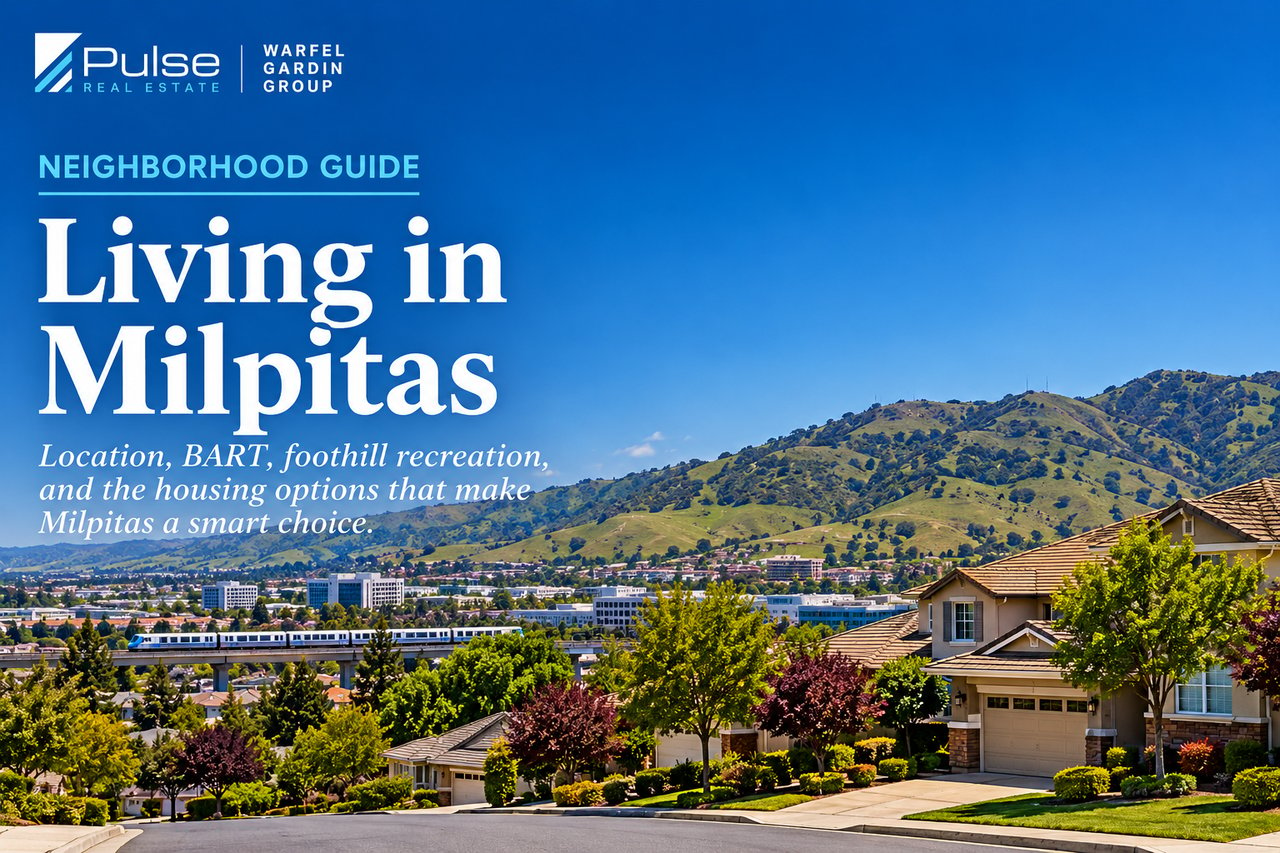
Homes, neighborhoods, BART, Silicon Valley access, foothill recreation, and what buyers should know before choosing Milpitas
You’ve got questions and we can’t wait to answer them.