Living in Santa Clara: A Neighborhood Guide for Home Buyers
Home Buying
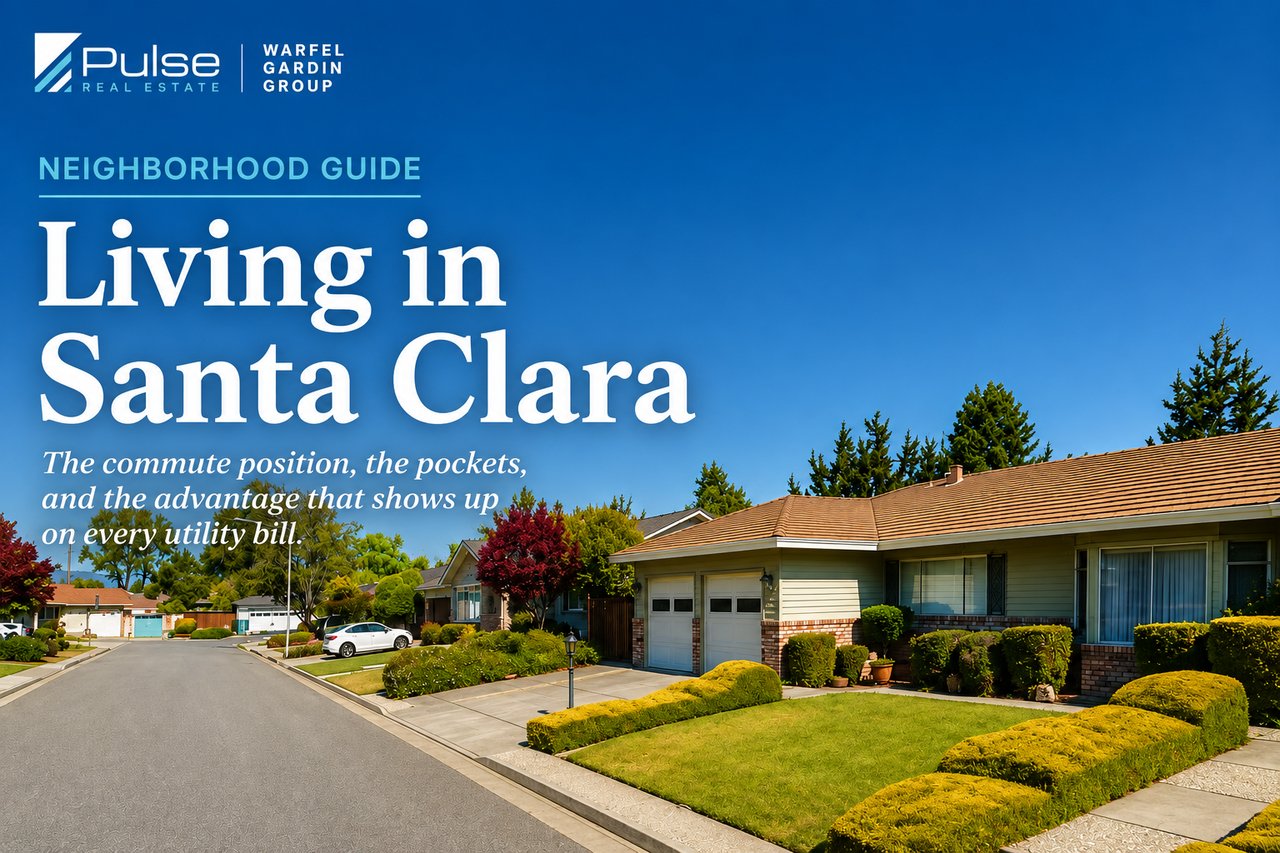
Home Buying
Santa Clara gets overlooked, and much of the reason is geography. It sits between Sunnyvale and San Jose, next to Cupertino, with Campbell and Los Gatos a short drive south. Buyers searching for a home in Silicon Valley often name those cities first. Santa Clara can become the place they drive through on the way to somewhere else.
That is worth reconsidering.
For the right buyer, Santa Clara offers a combination that is surprisingly difficult to find elsewhere in Silicon Valley: a central location near major employers, established single-family neighborhoods, generally lower home prices than Sunnyvale or Cupertino, and an unusual advantage that keeps paying off after you buy: the city's own electric utility.
Here is our practical guide to living in Santa Clara: the neighborhoods, commute, schools, housing, costs, trade-offs, and the buyers we think should have the city on their list.
Santa Clara is relatively compact, but one neighborhood can feel quite different from another. Much of that comes down to when the homes were built and how the surrounding area developed.
Old Quad and the Santa Clara University area. This is the historic heart of Santa Clara, near Santa Clara University and Mission Santa Clara. You'll find tree-lined streets and older homes with more architectural character, including Craftsman, Spanish-influenced and other early California styles.
Lots and homes vary considerably, but buyers who want an established neighborhood and the ability to walk to restaurants, coffee, the university and nearby amenities often start here.
Central Santa Clara and the postwar neighborhoods. This represents a large portion of Santa Clara's single-family housing. Think mostly one-story ranch homes built during the 1950s and 1960s on established residential streets.
The original floor plans tend to be modest by today's standards, but many homes have been expanded or remodeled over the years. That makes it especially important to compare individual properties rather than assume two similar-looking homes offer the same value.
For move-up buyers who want a single-family home and usable yard while staying close to Silicon Valley employment centers, these neighborhoods deserve a serious look.
Rivermark. Rivermark feels noticeably different from older Santa Clara. It is a newer master-planned community on the north side of the city with single-family homes, townhomes, condominiums and apartments built around parks, an elementary school and a retail center.
It appeals particularly to buyers who prefer newer construction, neighborhood amenities and a more planned, walkable environment. The trade-offs can include smaller lots, higher density and HOA dues depending on the property.
North Santa Clara near Levi's Stadium. Northern Santa Clara includes newer housing, office developments, Levi's Stadium, the convention center and major employment centers.
For buyers working in North San Jose, Sunnyvale or nearby tech campuses, the location can be extremely convenient. Buyers should also consider stadium and event traffic, neighborhood density and future development when evaluating a particular property.
For many home buyers, this is one of Santa Clara's strongest arguments.
Santa Clara sits near Highway 101, Highway 237, Interstate 880 and Interstate 280. Lawrence Expressway and San Tomas Expressway provide important north-south routes through the city and can matter just as much as freeway access for everyday commuting.
Santa Clara also has a Caltrain station, providing direct rail service along the Peninsula and to San Francisco. VTA light rail serves portions of North Santa Clara and the stadium area.
But the biggest advantage is simply where Santa Clara sits on the map.
Major employment centers in Sunnyvale, Cupertino, Mountain View, Palo Alto, North San Jose and Santa Clara itself are all within a relatively compact area.
That can make Santa Clara particularly attractive for two-career households where each person works in a different Silicon Valley city. Instead of optimizing one commute while making the other much more difficult, Santa Clara can provide a practical middle ground.
Commute times can change dramatically by time of day, however. We recommend testing the actual drive from a home you're considering to each workplace during the hours you would normally commute.
One of Santa Clara's most unusual advantages is easy to overlook when you're touring homes: the city has its own electric utility.
Most Santa Clara residents receive electricity from Silicon Valley Power (SVP), the city's not-for-profit municipal electric utility, rather than PG&E.
The difference in electricity costs can be significant. In Silicon Valley Power's published rate comparison, its 2026 average residential electric rate is approximately 18.2 cents per kilowatt-hour, compared with 42.2 cents per kilowatt-hour for PG&E based on the PG&E average rate used in SVP's comparison. That puts SVP's average rate about 57% lower.
These are average rates used for comparison, not a guarantee of what an individual household will pay. Actual electric bills depend on electricity use, applicable rates and other factors, and rates can change over time.
Still, the difference can be meaningful for a homeowner, particularly over many years of ownership or in a household with higher electricity use, such as one charging electric vehicles at home.
When comparing a Santa Clara home with a similar property in a neighboring city, we think electricity costs are worth including in the overall cost-of-ownership calculation.
It's an advantage that rarely gets mentioned during a home tour, but it can continue paying off for as long as you own the home.
Most of Santa Clara is served by the Santa Clara Unified School District, while some addresses may be served by other school districts.
This is an important Silicon Valley home-buying lesson: never assume the school district or assigned schools based solely on the city name.
School boundaries do not always follow city boundaries, and assignments can vary by address. Buyers interested in particular schools should verify current attendance boundaries directly with the appropriate school district before making a purchase decision.
Central Park is one of Santa Clara's major community assets, with recreational facilities, the Central Park Library and the International Swim Center nearby.
Santa Clara University also gives the surrounding area something many suburban Silicon Valley communities do not have: a traditional university campus with cultural events, athletics, lectures and a strong connection to the city's history.
Northern Santa Clara is likely to continue changing as well.
California's Great America has been part of Santa Clara for decades. Six Flags has indicated the park could close following the 2027 season unless the current arrangement changes. What ultimately happens with the property could have a significant effect on North Santa Clara, so buyers considering nearby neighborhoods should keep an eye on future plans for the site.
For many buyers, Santa Clara and Sunnyvale end up on the same search list.
The cities share some similarities: central Silicon Valley locations, large areas of postwar single-family homes and convenient access to major employers.
Sunnyvale generally has a stronger traditional downtown and can command higher home prices in many comparable neighborhoods.
Santa Clara can offer an opportunity to get more home for the budget while retaining excellent access to many of the same employment centers. Silicon Valley Power adds another potential long-term cost advantage.
If you're considering both cities, read our 2026 Sunnyvale Neighborhood Guide for Move-Up and RTO Buyers for a closer look at Sunnyvale.
The comparison with Cupertino is different.
Cupertino home prices are heavily influenced by demand for particular schools and proximity to major employers, including Apple. Buyers focused specifically on Cupertino schools may be willing to pay that premium.
But not every buyer needs to.
For buyers who value the location but are flexible about school districts, Santa Clara can provide a compelling alternative, particularly when the same budget can buy a larger home, larger lot or more updated property.
This is where comparing actual homes and recent sales becomes much more useful than comparing citywide median prices.
Campbell and San Jose's Willow Glen neighborhood tend to have an advantage when a buyer's priority is a lively, walkable downtown environment.
Downtown Campbell and Lincoln Avenue in Willow Glen offer restaurants, coffee shops, boutiques and the neighborhood atmosphere many buyers picture when they talk about wanting walkability.
Much of Santa Clara is more residential and practical.
Its strengths are different: commute flexibility, access to major employers, relative value and lower electric rates.
Neither choice is inherently better. It depends on what you want your everyday life to look like.
You can also read our 2026 Campbell Neighborhood Guide for Move-Up Buyers and 2026 Willow Glen Neighborhood Guide for Move-Up Buyers for a closer comparison.
Santa Clara belongs on the list for buyers who:
It may be less appealing for buyers whose top priority is having a large, walkable restaurant and nightlife district outside their front door.
It also may not be right for buyers whose home search depends on a particular school unless they have carefully verified the property's current school assignment.
Santa Clara is not trying to be Los Gatos, Willow Glen or downtown Campbell.
Its strengths are more practical: location, housing choices, commuting and long-term ownership costs.
For many Silicon Valley buyers, those are exactly the things that matter most.
For buyers who value commute flexibility, access to Silicon Valley employers and long-term ownership costs, Santa Clara can compare very well with its more expensive neighbors.
Whether it is right for you depends on your budget, commute, housing needs and school requirements. We recommend comparing individual Santa Clara neighborhoods and recent home sales rather than making the decision based on citywide averages.
Santa Clara homes will often be priced below comparable properties in Sunnyvale or Cupertino, but there are important exceptions depending on neighborhood, school assignment, lot size, condition and current inventory.
Instead of relying on median prices, compare recently sold homes similar to the type of property you actually want to buy.
Silicon Valley Power is the City of Santa Clara's municipal electric utility and serves Santa Clara residents. Buyers should still verify the utilities serving a specific property as part of their due diligence.
Much of Santa Clara is served by Santa Clara Unified School District, but buyers should verify the district and assigned schools for the specific property they are considering. City boundaries and school district boundaries do not always match.
For many buyers, yes. Santa Clara provides convenient access to major employers in Santa Clara, Sunnyvale, Cupertino, North San Jose, Mountain View and other parts of Silicon Valley.
The more important question is whether a particular Santa Clara neighborhood works for your commute. Test the route at the time you would normally travel rather than relying solely on a mapping app's average estimate.
Santa Clara offers a mix of older single-family homes, particularly 1950s and 1960s ranch homes, historic properties near the Old Quad, and newer single-family homes, townhomes and condominiums in areas such as Rivermark and North Santa Clara.
That variety gives buyers options at different price points, but it also means home condition, lot size, remodeling and neighborhood character can vary considerably.
Santa Clara rewards buyers who look beyond the first impression.
Some of its housing is modest from the street. It doesn't have the downtown identity of Campbell or the name recognition of Cupertino.
But look at what you actually get.
A central Silicon Valley location. Access to major employment centers. Established single-family neighborhoods. A range of housing options. Generally lower prices than some neighboring cities. And an electric utility whose published average residential rate is substantially below the PG&E rate used in its comparison.
Those advantages may not be the first things you notice when scrolling through listing photos.
They can matter quite a bit once you own the home.
Finding the right Santa Clara home is less about deciding whether you like "Santa Clara" and more about finding the particular streets and properties that fit your priorities.
We help buyers compare neighborhoods, evaluate recent comparable sales, understand how location affects value, verify school and utility information, and think through the trade-offs between Santa Clara and nearby communities such as Sunnyvale, Cupertino, Campbell and San Jose.
With 425+ home sales and more than 160 five-star reviews, we've helped buyers and sellers throughout Silicon Valley make these decisions based on the details, not just a citywide statistic or an online estimate.
Considering buying a home in Santa Clara or elsewhere in Silicon Valley? Call or text Dale and Helen at 408-647-7211. We'd be happy to talk through what you're looking for and help you determine which neighborhoods make the most sense.
More neighborhood guides:
Posted by Dale Warfel and Helen Gardin, The Warfel Gardin Group at Pulse Real Estate
Stay up to date on the latest real estate trends.

Home Buying
What Buyers and Sellers Should Know
Home Buying
Neighborhoods, homes, schools, commute considerations, and what buyers should know before choosing Palo Alto
Home Buying
Larger properties, established neighborhoods, Saratoga Village, foothill living, and what buyers should know before choosing Saratoga

Home Buying
Foothill neighborhoods, more room to move up, and what buyers should know about life in East San Jose
You’ve got questions and we can’t wait to answer them.